Hospitals, clinics and labs
AI for hospitals and clinics, without sending patient data anywhere
Cloud AI services read every record they are shown on another company’s servers, and most are not available from Iran anyway. TehranQ runs an open-weight model on a server inside your hospital or clinic. Staff draft letters, look things up in your own protocols and turn dictation into text, in Persian and English, and patient records stay on your network.
- Hospitals and clinics
- Medical and diagnostic labs
- Pharmaceutical companies
- Health insurers
Why local matters here
Patient records are among the most sensitive data any business holds, and you answer for them. Once a record has been pasted into a cloud service, you cannot check where it went or who read it. With your own model nothing leaves the hospital network, it keeps working with no internet, and an audit log nobody can edit shows who signed in and what each admin changed.
What your staff could do with it
Your protocols, answered in Persian
Keep clinical protocols, nursing guidelines and the hospital formulary as shared contexts. A nurse or a resident asks in plain Persian, from a computer or a phone’s browser, and the model answers from the documents switched on in the chat. For anything that matters, they open the protocol itself.
Shared context →Dictation and meetings into text
Record a dictated report, a case conference or a committee meeting, and the speech tool turns it into Persian or English text with timestamps. Paste the text into a chat to tidy it into your report layout. Names, doses and numbers are where it slips, so a clinician checks every line.
Speech →Letters, discharge summaries and handouts
Draft a referral letter, a discharge summary from the doctor’s own notes, or an instruction sheet a patient can follow, in Persian or English. Attach the notes as a file or paste them in. The clinician edits and signs; the model only saves the typing.
Workspace →English papers, summarised in Persian
Attach up to four PDFs of papers or clinical guidelines to a message and ask for a Persian summary, how they differ, or their methods side by side. Useful for research units, pharma teams and journal clubs. A scanned PDF has no text in it and needs OCR first.
Workspace →Coverage rules and member letters
For a health insurer: keep coverage rules and claim criteria as shared contexts, so an assessor can check a case against your own rules and get a draft of the letter to the member. The decision on the claim stays with the assessor.
Shared context →Your HIS and lab system, for IT and reporting staff
Connect a hospital or lab information system that has an API, read-only if you prefer. People who work in VS Code, JetBrains or Continue can then look up a record or build a report through your own model. Each person reaches only their own apps, and every call is in the audit log. The Workspace’s own chat does not reach these apps yet.
Integrations →Sample: a patient handout from a discharge summary
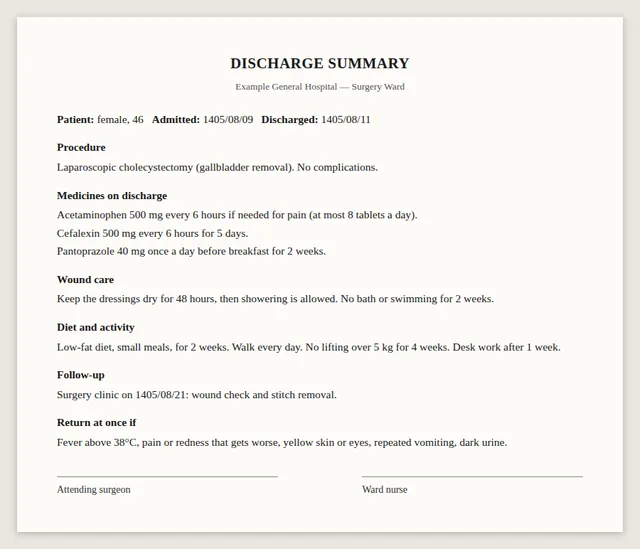
A made-up discharge summary after gallbladder surgery, and the nursing team’s rules for patient handouts. This is how it goes in the Workspace.
- 01
The handout rules, written once
The nursing team keeps its rules as a shared context: plain words, the sections in a fixed order, and nothing that is not in the doctor’s summary.
- 02
The summary, as a scan
A nurse attaches a scan of the discharge summary, switches the rules on, and asks for the handout.
- 03
The handout, then a clinician
The model writes the handout: medicines with doses and how long, wound care, eating, activity, the next visit, and when to come back at once. A clinician checks it before it reaches the patient.
Turn this discharge summary into a one-page handout for the patient, following our handout rules.
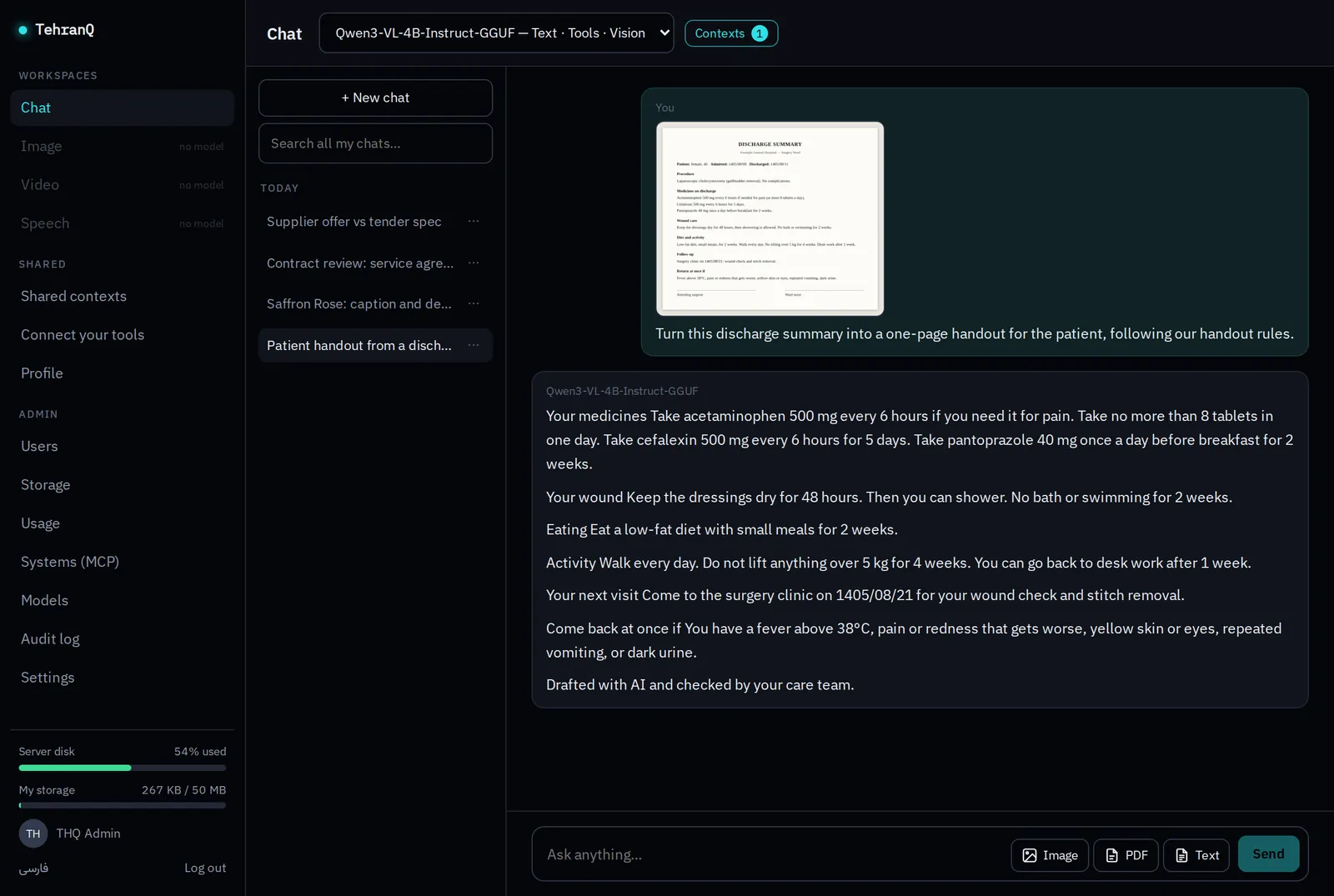
Answered by Qwen3-VL-4B, which reads images, on a laptop’s 6 GB GPU in about 8 seconds. It is not for diagnosis or treatment decisions: a clinician checks every handout.
Shared contexts a hospital or lab keeps
- Clinical protocols and nursing guidelines
- The hospital formulary
- Templates for discharge summaries, referrals and patient handouts
- Lab procedures and quality documents (SOPs)
- Coverage rules and claim criteria, for insurers
Apps a hospital, lab or insurer might connect
- The hospital information system (HIS), read-only
- The lab information system (LIS)
- Appointment booking
- Claims and billing
What it takes
A clinic where a few people ask questions at a time starts on a 12 GB graphics card with an 8B model. A hospital department working with it at the same time wants 24 GB or more: the number follows how many people use it at once, not the headcount. Transcribing dictation is a load of its own, about 10–12 GB, and connecting your HIS or lab system needs a capable model, 14–35B, with a card to match. The System builder works out the machine.
Size your system →Where it falls short
It is not for diagnosis or treatment decisions. Everything it writes is a draft, and a clinician checks it before it reaches a patient or a record. Persian medical terms and drug names come out wrong often enough that each one needs a second look. Scanned records have no text for it to read until they go through OCR. Transcribed dictation needs checking, above all names, doses and numbers. And it reads only what is in the chat, the attached files and the shared contexts switched on; it does not search your archive of records by itself.
Questions hospitals and clinics ask
Can it help with diagnosis?
No, and it should not be used that way. It drafts, summarises and finds answers in your own documents, and it can be wrong while sounding sure. Clinical decisions stay with the clinician, and everything it writes is checked before use.
Does patient data leave the hospital?
Not through the Workspace or the speech tool: both run on your server and work with no internet. Cloud tools such as Cursor and Claude, if someone connects them, send what they read to their provider, so keep them away from patient data. The Workspace warns about this when they are set up.
How good is it with Persian medical language?
Good at plain Persian writing, such as letters and patient handouts. Medical terms and drug names are where it slips most, so review them every time. Transcription of Persian dictation is also less accurate than English.
Can it read our scanned files?
A scanned PDF is a picture of text with no text inside, so the model cannot read it until it goes through OCR; the Workspace says so when one is attached. PDFs made on a computer, and text files, it reads directly.
Who can see which documents?
Each person has their own chats. A shared context is private or shared with everyone, and an admin can assign one to a particular person. The roles are user, admin and THQ Admin, and the audit log records sign-ins and admin changes; nobody can edit it.
Other industries
Tell us about your business
Say what your team does and how many people; we will tell you what it would take — and if it is not worth it for you, we will say that too.
Request an assessment