01
It is not available here
OpenAI, Anthropic and Google do not serve Iran. Whatever you are using today is a workaround, and workarounds close without warning. The day it closes, your team stops working.
On-premises AI deployment
We specify the system, deploy open-weight models on hardware you own, and maintain it afterwards. Your data never leaves the building, there is no per-token bill, and it keeps working without internet.
A three-person team of developers and hardware engineers
Why local
01
OpenAI, Anthropic and Google do not serve Iran. Whatever you are using today is a workaround, and workarounds close without warning. The day it closes, your team stops working.
02
Per user, per token, priced in dollars. One month of heavy use can cost what the entire machine costs. Hardware is bought once. A subscription comes back every month.
03
Contracts, client records, source code, internal mail. Once it is sent, deletion is a promise rather than something you can verify yourself.
NVIDIA builds desk-side AI machines for developers. The company with the most to gain from renting you cloud GPUs also sells hardware to people who will not rent. The reason they do it is the reason we do this.
Your industry
What we deploy
Every model is open-weight. The weights sit on your disk, no request leaves your network, and if we disappeared tomorrow the system keeps running.
01Chat & documents
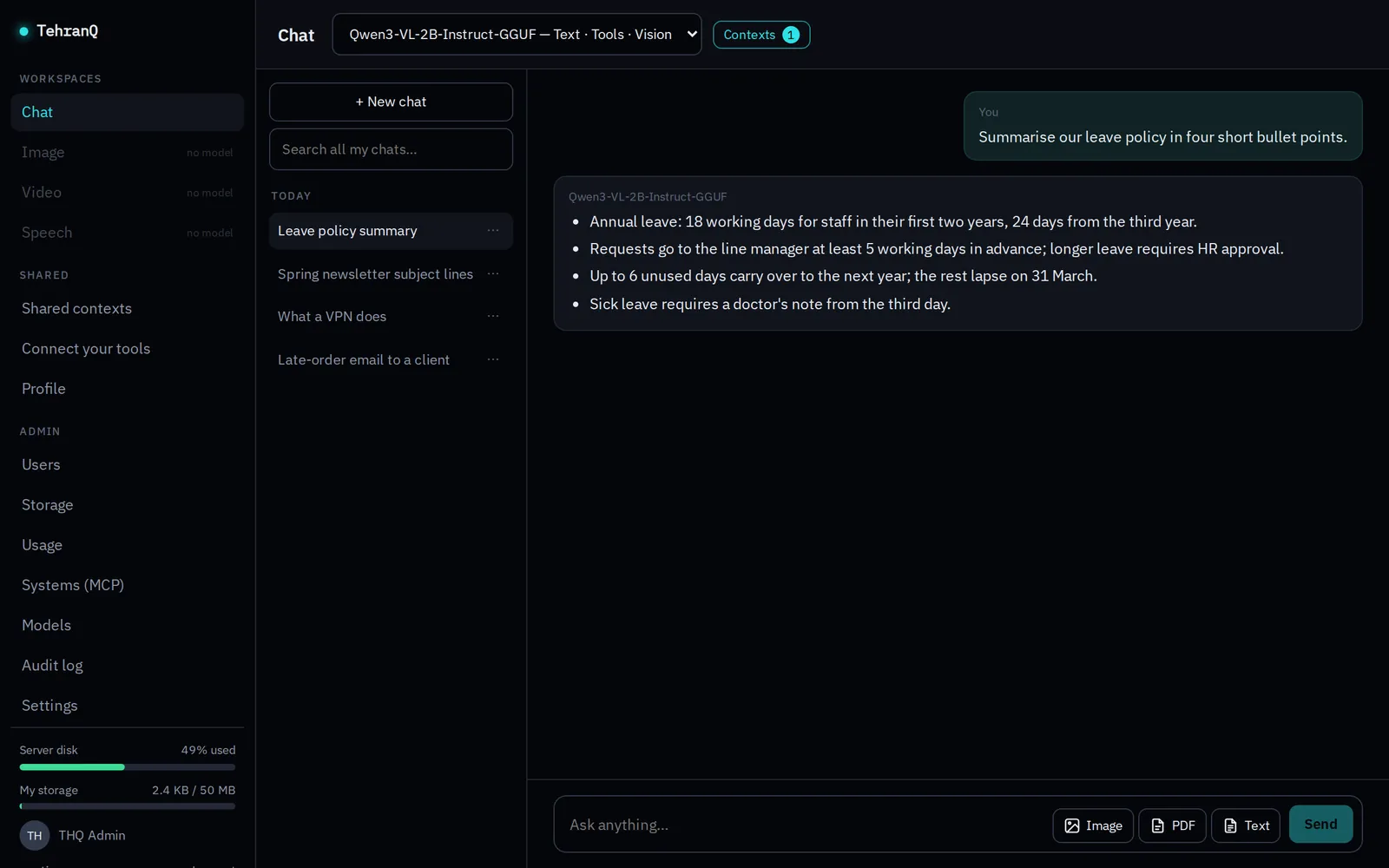
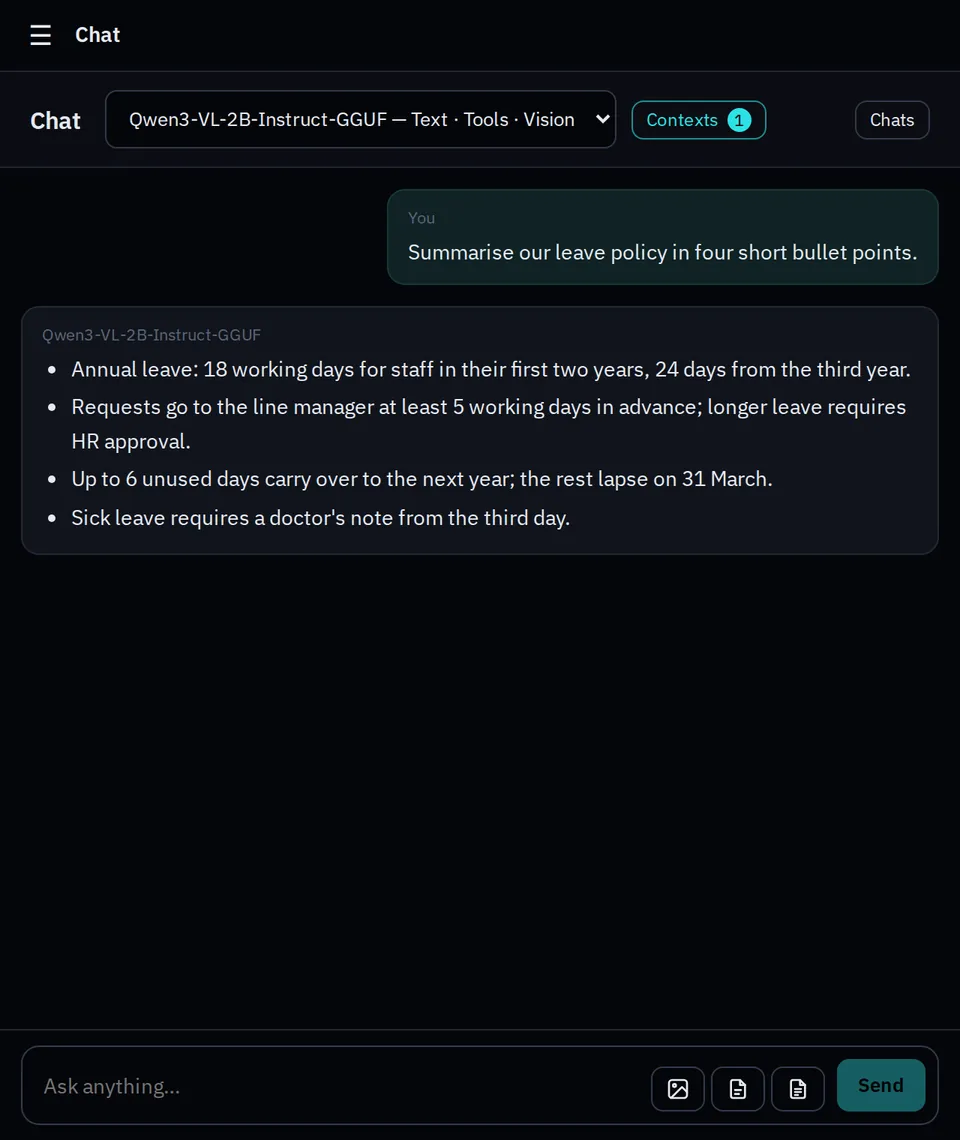
The model runs on your server, and your team chats with it in the browser, on a computer or a phone. They attach the images, PDFs and files a question is about, and share context — policies, price lists, project briefs — so everyone works from the same knowledge. For most companies this is the part that proves its value fastest.
02Coding
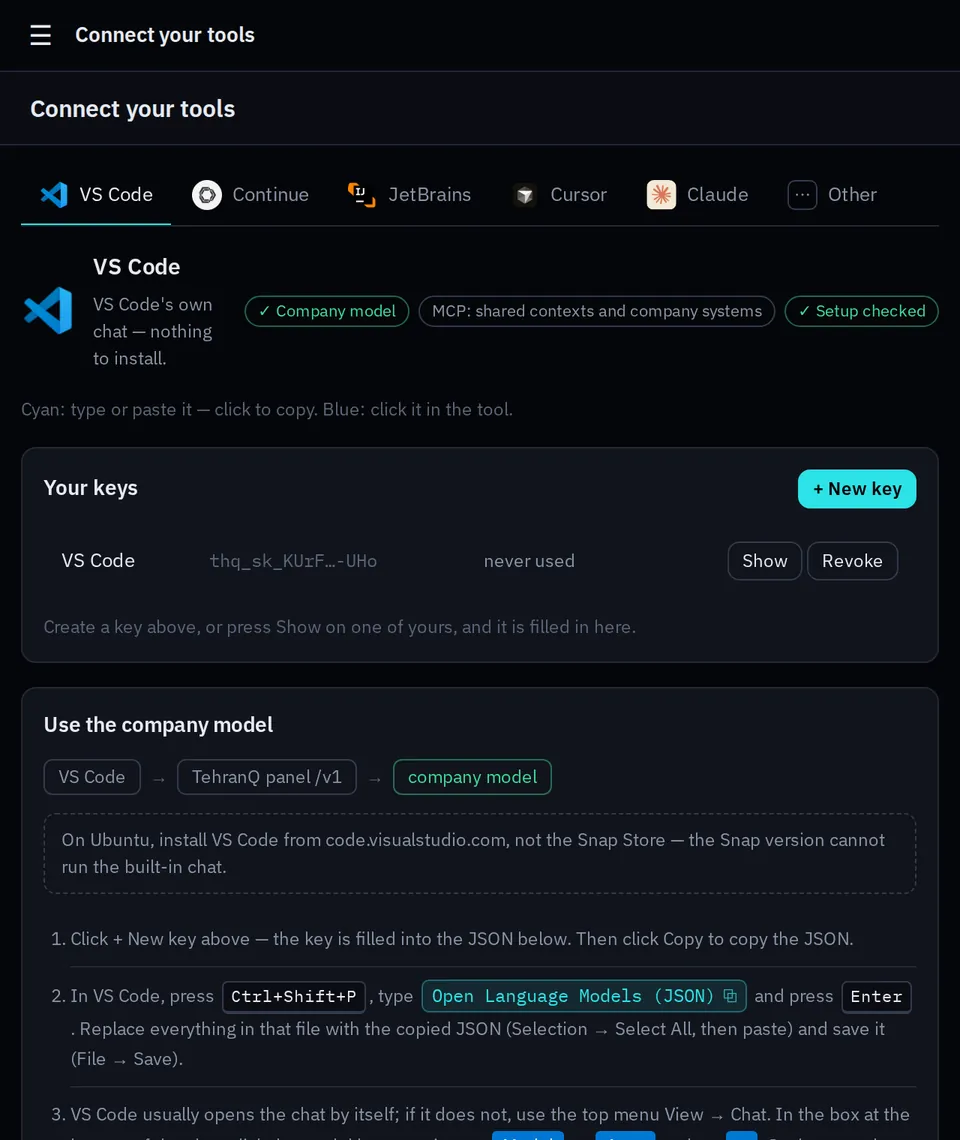
The model runs on your server and works inside your team’s own IDE: VS Code, JetBrains, Continue. No paid online assistant, no per-seat bill, and source code never leaves the network. For software teams this is the fastest return in the list.
03Image
For marketing, product mockups, banners and internal visuals. It runs on a mid-range card and is the quickest of these to stand up.
promptproduct photo on a clean background, soft light
04Speech
Speech to text for meetings, support calls and audio archives, plus text to speech. It is light enough to sit alongside the other services on the same machine.
05Video
Short clips for advertising and social channels. It is the heaviest thing you can run locally and wants the most VRAM and the most compute time of anything here.
06Integrations
MCP is the standard AI tools use to reach other software. Through it, the model helps your team work with your own apps — CRM, ERP, ticketing, internal APIs — from VS Code, JetBrains, Cursor and other tools: look up a customer, open a ticket, assemble a report. Each person reaches only their own apps, critical actions are only for the people named, and every call goes into the audit log.
The model stops just talking — it reaches your own systems and does the work.
What we hear most
"Open-source models are not as good as the paid ones."
On the hardest reasoning work, that is true — frontier models are ahead, and we are not going to claim otherwise. But that is not what a company does all day: summarising, drafting, pulling information out of files, answering questions from internal documents, completing code. On that work, current open-weight models are genuinely good enough.
The job is matching the model to the task, not claiming parity. Anyone telling you a local model equals a frontier model in every respect is either wrong or selling something.
Models we deploy
This is the same list the sizing engine works from, so the numbers you see in a specification agree with this table. When a better model appears, it replaces one of these.
| Model | Parameters | VRAM | Disk |
|---|---|---|---|
| Qwen3 4BLanguage | 4.02B | 2.5 | 2.5 |
| Qwen3 8BLanguage | 8.19B | 5.03 | 5.03 |
| Qwen3 14BLanguage | 14.77B | 9 | 9 |
| Qwen3 32BLanguage | 32.76B | 19.76 | 19.76 |
| QwQ 32BLanguage | 32.76B | 19.85 | 19.85 |
| Qwen3-Coder 30B A3BLanguage | 30.53BMoE · 3.3B | 18.56 | 18.56 |
| DeepSeek-R1 Distill 14BLanguage | 14.77B | 8.99 | 8.99 |
| DeepSeek-R1 Distill 32BLanguage | 32.76B | 19.85 | 19.85 |
| Devstral SmallLanguage | 23.57B | 14.33 | 14.33 |
| Llama 3.3 70BLanguage | 70.55B | 42.52 | 42.52 |
| Mistral Nemo 12BLanguage | 12.25B | 7.48 | 7.48 |
| Codestral 22BLanguage | 22.25B | 13.34 | 13.34 |
| Granite 3.3 8BLanguage | 8.17B | 4.94 | 4.94 |
| Llama 3.1 8BLanguage | 8.03B | 4.92 | 4.92 |
| Gemma 3 4BLanguage | 4.3B | 2.49 | 2.49 |
| Gemma 3 12BLanguage | 12.19B | 7.3 | 7.3 |
| Gemma 3 27BLanguage | 27.43B | 16.55 | 16.55 |
| Phi-4 14BLanguage | 14.66B | 8.89 | 8.89 |
| Mistral Small 3.2 24BLanguage | 24.01B | 14.33 | 14.33 |
| Qwen2.5-Coder 7BLanguage | 7.62B | 4.68 | 4.68 |
| Qwen2.5-Coder 32BLanguage | 32.76B | 19.85 | 19.85 |
| gpt-oss 20BLanguage | 21.51BMoE · 3.6B | 11.62 | 11.62 |
| gpt-oss 120BLanguage | 116.83BMoE · 5.1B | ~70 | 70.1 |
| GLM-4.5 AirLanguage | 110.47BMoE · 12B | ~66 | 66.3 |
| DeepSeek-R1 Distill Llama 8BLanguage | 8.03B | 4.92 | 4.92 |
| Qwen3 235B A22BLanguage | 235.09BMoE · 22B | ~141 | 141.1 |
| bge-m3 (embeddings)Embedding | 0.57B | ~2.5 | 2.3 |
| SDXLImage | — | ~7 | 14 |
| Pony (SDXL)Image | — | ~7 | 14 |
| FLUX.1 devImage | — | ~24 | 24 |
| Stable Diffusion 1.5Image | — | ~4 | 4 |
| FLUX.1 schnellImage | — | ~24 | 24 |
| Stable Diffusion 3.5 LargeImage | — | ~18 | 16 |
| Stable Diffusion 3.5 MediumImage | — | ~7 | 6 |
| Qwen-ImageImage | — | ~40 | 41 |
| Whisper large-v3Speech | — | ~5 | 3.1 |
| LTX-VideoVideo | — | ~12 | 20 |
| Wan 14BVideo | — | ~32 | 34 |
| Wan 2.1 1.3BVideo | — | ~10 | 8 |
| CogVideoX-5BVideo | — | ~18 | 22 |
| HunyuanVideoVideo | — | ~45 | 50 |
Memory figures assume 4-bit. Actual VRAM also depends on concurrent users and context length — the calculator accounts for both.
How this works
About two weeks of our work. Three to six weeks end to end, and the variable is hardware supply rather than us.
1–2 days
How many people, how many of them at the same time, for what work, with what network isolation, and what hardware you already own.
2–4 days
A complete build sheet: GPU, CPU, motherboard, RAM, storage, PSU, cooling, electrical and UPS. You can buy against it from any supplier you trust.
1–3 weeks
You buy, we advise. This is the longest stage and it depends on market availability, not on us.
2–3 days
Build and test under sustained inference load — thermals, draw and stability, not just that it powers on.
3–5 days
OS and drivers, then TehranQ from one install package that needs no internet: the Workspace, the model on the GPU, sign-in, network isolation and backups.
2–5 days
Shared contexts from your own documents, the company instructions, the people and their storage, and who sees what.
1 day
A workshop for staff, and a separate session for whoever maintains it afterwards.
Handover
Documentation, access, and a month of support. A maintenance contract after that is optional.
If you already own the hardware, procurement disappears and the whole thing is about two weeks.
After it is running
Open-weight models jump forward every few months. A maintenance contract means new models installed and swapped in, the system monitored, and someone to call when something breaks.
When a general model does not know your field's terminology or tone, we train it on your own data — Persian legal and medical vocabulary, or the format of your internal reports.
Most failed deployments were not technical failures; nobody used them. We teach your team how to get work out of the system, and where not to trust it.
Control
For individuals
You do not have to be a company. If you are a researcher, developer or freelancer who wants to run models on your own machine, you get the same assessment and the same build sheet at a smaller scale.
ChatGPT is a cloud service run by OpenAI, and OpenAI does not serve Iran. TehranQ installs open-weight models such as Qwen, DeepSeek and Llama on your own server: a chat much like ChatGPT in the browser, except that no data leaves the office and there is no bill per user or per token. Frontier models are ahead on the hardest reasoning; for a company’s everyday work, open-weight models are good enough.
No. The system runs on your own network and works without the internet, and it installs from an offline package. People connect from a browser on a computer or phone, and from outside the office through your company’s own VPN.
Yes. For chat, Qwen3, Qwen3-VL (which also reads images), DeepSeek and Llama; for coding, Qwen3-Coder, DeepSeek-Coder and Devstral. For each job we install the model that does best on your own work and that your hardware can carry.
Larger models read and write Persian well. Very small ones are weaker in Persian and sometimes get it wrong, so we size the model against samples of your own Persian work, not an English benchmark.
It depends on how many people work at once and what they do: chat and coding are lighter, image and video generation heavier. The system builder works out the GPU, VRAM, CPU, RAM, PSU and UPS; a personal system for one person is possible too.
On your own server, inside your company network. The model files sit on your own disk and no request goes out; if we were gone tomorrow, the system would keep working.
Start here
The first conversation costs nothing. If we conclude a local system is not worth it for you, we will say that — better than selling you something that ends up gathering dust.
Request an assessment